
1st Tournament of the Year
On Thursday the 12th of October the first over 16 tournament of the year took place in ACS. Six international schools took part in the tournament. Our boys competed in volleyball and our girls in football.
After a long day, packed full of matches, our girls finished in 3rd place and our boys in 4th. Well done to all the team members for their valiant effort.
A special thank you to the coaches Mr Styliati and Ms Dikaioulia for their work with the school teams.
Finally, we look forward to the tournament which our school will host on Wednesday the 18th of October.
Forensics 2023
After two years of online Forensics tournaments, the competition was live again this year, bringing back the real feeling of Forensics to all participants.
The SLC Team participated with great enthusiasm as always. With 2 finalists and 1 honourable mention, we ranked 5th out of 21 schools!
Our two finalists were: Zoe Courts, Year 10,(Oral Interpretation Comic) and Lydia Stephenson, Year 12, (Impromptu Speaking). Our Honourable Mention was the team president, Myrto Denediou, Year 13, (Oral Interpretation Comic).
Congratulations to all who participated, and many thanks to the teachers who were involved supporting the team, coaching them, judging and generally being part of this great, annual event: Ms Stafford, Mr Courts, Mr Strzemiecki, Ms Kladouchou, Ms Iliadou, Ms Torres.
First Day Back!
Here we are at the start of an exciting new school year, the academic year 2021-2022. As St Lawrence College enters its forty-first year, the pupils have made a super start. They have come into school today with smiles on their faces and a spring in their step. The classes are calm and teachers are getting to know their children already. It’s an exciting time and we are all prepared for whatever we may face this year!
Here’s to a successful year ahead!
Swimming Gala 2017
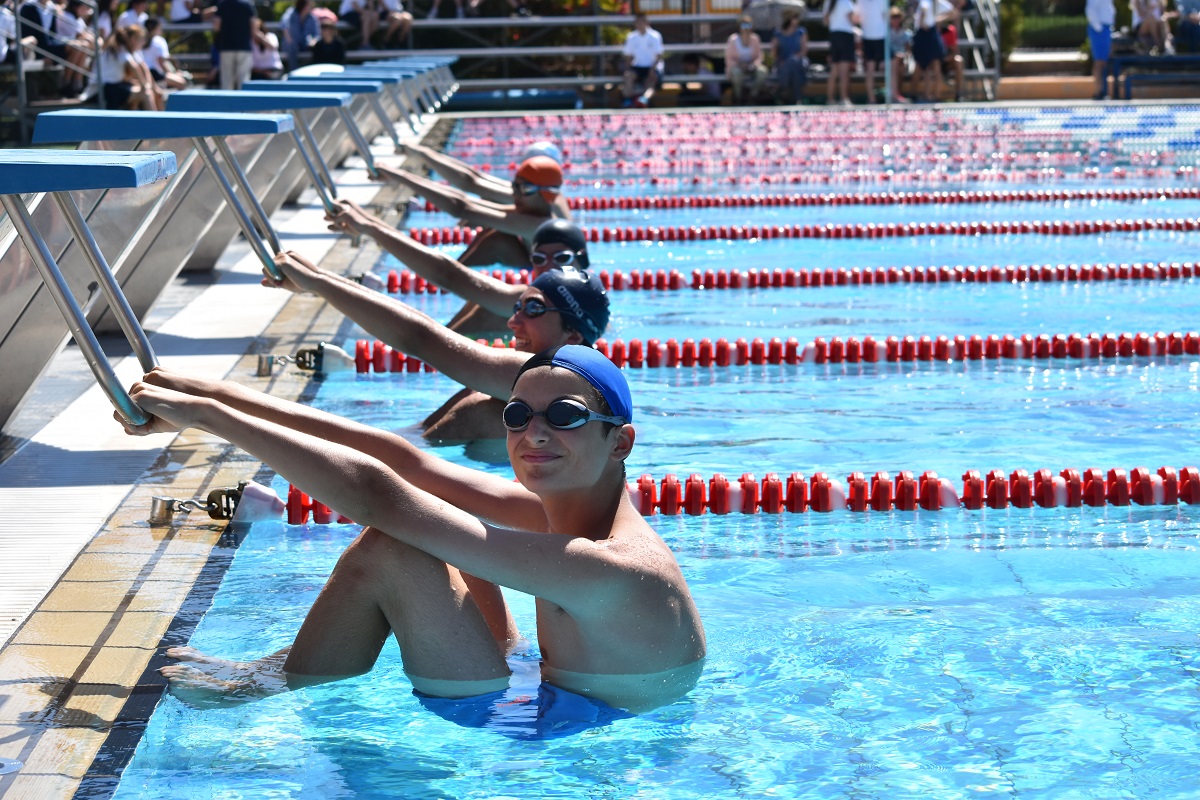
The annual St Lawrence College Swimming Gala took place on Thursday 11th May in the beautiful Athens sunshine. After some tight races and some incredible victories, the results were as follows:
Attica: 630
Epirus: 980
Macedonia:1050
These points will be added to the Sports Day totals to decide the final scores at the end of the year.
We also have some new school records to add to our record book:
50 m freestyle year 8 girls: 35,62 Emily Valmas
50 m breaststroke year 8 boys: 37,82 Angelos Mylonas
50 m breast stroke year 8 girls : 44,02 Katrina Lemane
Congratulations to everyone who took part and we look forward to seeing you all at the end of year celebrations where our house champions will be formally announced.
Public Exam Success
Public Exam Success – 4th best exam results over last 10 years
Summer 2015 results
IGCSEs –
- 59 candidates sat for a total of 506 IGCSE exams
- 53% of all IGCSEs taken resulted in A*/A grade
- 86% of all IGCSEs taken resulted in A*-C grade
- 98% of all IGCSEs taken resulted in A*-G grade
AS and A-Levels –
- 80 candidates sat for a total of 292 AS and A-Level qualifications
- 41% of all AS & A-Levels sat for resulted in an A*/A grade (A* is not available at AS-Level)
- This represents best rate of A*/A grades in last five years
- There were 20 A*s at A-Level – more than in any previous year
- More pupils got multiple A*s at A-Level than in any previous year
- 83% of all A-Levels were awarded a C grade or better
Greater detail is given in exam results video posted on this website within two weeks of the release of all results and also posted on SLC’s Facebook page
For videos from previous years click below
2015 – click here
2014 – click here
2013 – click here
2012 – click here
Key Stage 1
(Years 1 and 2)
Key Stage 1 covers Years 1 and 2 of primary education and builds on children’s early learning by introducing a broader, more structured curriculum. At this stage, pupils begin to deepen their understanding of core subjects while developing greater independence and confidence as learners.
In Year 1, the curriculum expands to include a range of subjects delivered through engaging, topic-based learning. Alongside class teachers and teaching assistants, pupils benefit from the expertise of specialist teachers in subjects such as Music, Computing, and Greek language, which is introduced during this year. Teaching is carefully differentiated to meet the individual needs of each pupil, ensuring strong progress in literacy, numeracy, science and beyond.
Our experienced staff foster a nurturing environment that balances high academic expectations with personalised support. Teachers and teaching assistants work closely to ensure pupils are continually challenged while also receiving the encouragement and guidance they need to succeed.
a nurturing environment that balances high academic expectations with personalised support
By the end of Year 2, children have developed into capable, curious, and confident learners. They are well-prepared for the transition into Key Stage 2, equipped with a solid foundation in essential skills and the enthusiasm to embrace new challenges. Throughout their time in Key Stage 1, pupils benefit from a rich, supportive learning environment where each individual is valued and empowered to achieve their best.
Speech Day – Last day of Academic Year
Speech Day – Last day of Academic Year
Mental Health Week - let’s talk about mental health!
From 9th-13th October the senior school had some interesting events happening for Mental Health Awareness Week.
To get the ball rolling, on World Mental Health Day the assembly by Ms Perraki was all about ending the stigma attached to mental health. All pupils and teachers in the senior school wore stickers of a green ribbon for the day showing our support for reaching out and talking about mental health. Also, some Year 12 and 13 pupils took fun photos of senior school pupils and staff with helium balloons and our St. Lawrence College mental health matters photo frame at short break and lunch. It was incredibly popular, and it was great to see so many people enjoying the photoshoot!
On Wednesday 10th October all the senior school had extended form for ‘Friendship Form’. An older and younger form group were paired up and pupils had the opportunity to discuss scenarios about mental health support and the older pupils shares advice with younger pupils. We will have some more Friendship Form opportunities at regular intervals in the year to encourage the cooperation and interaction between different year groups. At lunchtime on Wednesday, Ms Michaelides ran a yoga session for staff and pupils to enjoy. The Year 7 and 8 pupils that attended really enjoyed the session.
During the week the Art, PE, Science, EAL and PSHE lessons had an array of happenings related to mental health. Pupils in Years 10-13 did an activity about managing stress in form time to get pupils to consider how to manage pressures they may face.
Around school, wall displays also raised awareness of the importance of looking after your mental wellbeing and ending the stigma attached to mental health.
The Pastoral Team ensure that mental health is considered every day at St. Lawrence College, but this very varied week was much appreciated and supported by all our school community.
Race For The Cure
As with every year since this event started in Athens, back in 2009, our school participated in the ‘Race For The Cure’ at the end of last month. This event is very close to the hearts of many pupils, teachers and parents and has become an event that gathers all of us together at the beginning of every school year. The event is organized in Greece by the “Panhellenic Society of Women with Breast Cancer, ALMA ZOIS” with the aim to support women who have or had breast cancer and to raise awareness of prevention of this disease.
‘Race for the Cure’ started in 1983 in the city of Dallas, in the USA and from the first event's 800 participants, the concept has now expanded to annual Races that attract hundreds of thousands of participants in more than 120 locations globally.
‘Race for the Cure’ has now become the biggest sporting event for women’s health in Europe. It helps breast cancer organisations and hospitals to collect funds and raise awareness. With 500,000 new diagnoses and 125,000 people who die of breast cancer in Europe every year, these funds are of vital importance. This year, as with 2020, the ‘Race’ could not happen in Greece, nor in most countries, in the usual way with the physical presence of participants due to measures to protect against COVID 19. It was not cancelled however, and instead took place ‘virtually’, with participants being encouraged to do their own walk or run. In St. Lawrence College, pupils from all year groups performed a walk or run during their PE lessons and many teachers also completed a run or walk during their lunch times, to show once again that our community is stronger than ever in the belief that breast cancer can be prevented and cured. Each participant donated some money and altogether through these events we raised €1,030 which has already been handed over to the ‘Race For The Cure’ organisation. Well done to each and every person who took part in these events and contributed generously to this important cause.
Model United Nations – The MUN Club
The MUN Club meets once a week at lunchtime throughout the year and welcomes pupils of Year 8 and above.
The aim of the Club is the participation in organised and official MUN events. The Club is informal but instructive in its style and content, teaching children, year after year, about the work of the UN, current world affairs and the world of diplomacy. Simultaneously, pupils develop their skills of research, teamwork, public speaking and listening.
...pupils develop their skills of research, teamwork, public speaking and listening.
Children are encouraged to conduct online research in order to locate information related to the topics of their chosen committees. They are also expected to prepare resolutions that must be presented to the committees afterwards.
The MUN Club activities help children acquire knowledge and develop critical thinking that will prove valuable to them both within and beyond the classroom. They also help pupils understand the specifics of planning and strategy and teach them how they can persuade others by using arguments as well as existing laws and treaties.
The MUN experience ensures that children understand, appreciate and respect the differences between people of various nations and encourages them to start building friendships that can last a lifetime. What’s more, it helps pupils develop team work as well as strategic skills, gain confidence around speaking and presenting arguments in front of an audience and gives them a different perspective and direction by opening new frontiers for them, both inside and outside school.
Since it is open to all pupils from Year 8 and above, the MUN Club gives children of different ages the chance to work together by helping each other and exchanging experiences and knowledge towards a common goal.
Assessment Information - Junior School
The assessment of pupils takes two main forms: formative and summative.
Formative assessment takes place daily. It allows teachers to monitor children’s progress across all subjects and ensures they receive the feedback they need to move forward in their learning. Teachers continually assess understanding in order to adapt planning and meet the needs of every child in each lesson. This ongoing process also informs longer-term planning, ensuring that every pupil is supported to make sustained progress.
adapt planning and meet the needs of every child
Summative assessment provides a snapshot of performance and usually takes place at the end of a unit, term, or academic year. At St. Lawrence College, we combine information from standardised testing systems with teacher judgements based on classroom observations to ensure accuracy and reliability. Class teachers carry out regular assessment of academic achievement, with differentiation applied at every stage to meet individual needs.
Cambridge Early Years and Primary Insight Assessments
In the Early Years, two baseline assessments give teachers a snapshot of where children are in their learning when they begin school or nursery: ASPECTS (for 3–4-year-olds) and BASE (for 4–5-year-olds), both developed by Cambridge Insight. These provide valuable information about each child’s starting point.
From Year 1 onwards, pupils take part in Cambridge Primary Insight (for ages 5–11), a broad range of digital, adaptive, formative assessments from Cambridge Insight. These are used for diagnostic purposes and to track pupil progress effectively over time.
In Key Stage 2, assessment is supplemented by in-house subject reviews, and in Year 6, pupils undertake end-of-year attainment testing based on the Cambridge Primary curriculum. These tests measure pupils’ knowledge, understanding, and skills in the core subjects of English, Mathematics, and Science.
Key Stage 4 Adventures in Santorini
The Year 10 pupils enjoyed a school trip to the stunning island of Santorini from Thursday 25th –Sunday 28th May. Their first day on the island commenced with a memorable visit to the archaeological site of Akrotiri to see the ancient town that had been frozen in time by ash from the volcanic eruption 3,600 years ago. Pupils were amazed to see how advanced the ancient homes were with earthquake proof designs, fully equipped bathrooms, water storage and sewage systems etc. Afterwards, they toured the Koutsogiannopoulos Estate to see how wine has been grown by the family on the island since the 1600s. Pupils learned about the history of wine and the machinery used as well as seeing the stages of the winemaking process. They then enjoyed some relaxation with a swim and a delicious lunch in a taverna on Perissa beach, famous for its black sand. After lunch, the Year 10 pupils went to the Industrial Museum of Tomatoes in Vlychada to learn everything about the small, cherry-sized tomatoes of Santorini! They saw how these famous tomatoes of Santorini are cultivated, processed and produced. Each pupil had the opportunity to make a Nomikos tomato paste tin can, to take home as a souvenir, using the machinery from the heyday of the factory. Then it was time to visit Oia to enjoy a walk around this well-known town and take plenty of photos.
The following day involved a boat tour over to the volcano in the middle of the caldera and pupils climbed to the top of the crater. They saw all the interesting volcanic rock formations and even smelt the sulphur gases that were being released from the fumeroles near the peak. Some of the Year 10s then braved the cold waters of the caldera to swim to the hot springs. There they bathed in the warm waters and enjoyed making body masks using some of the rich, mineral muds. Afterwards, the teleferik ride took them up to Fira, Santorini’s capital, to enjoy some free-time walking around the cobbled streets and shopping for souvenirs whilst appreciating the panoramic views out to sea. From Fira there was a walk along the top of the caldera past picturesque villages to Imeroviglii. The views were awe-inspiring!
On the final day it was as if everyone had taken a step back in time in the traditional village of Emporeio. A wander around the quaint village allowed the pupils to catch a glimpse of the quieter side of life in Santorini. Before heading back to Athens everyone enjoyed a hearty meal in Fira.
All in all, the Year 10 pupils enjoyed an action-packed trip. They learned lots about the geography, history and culture of Santorini and much fun was had by all!
Forensics Success
Another very successful year for the SLC Forensics team, as our Debate Team won for an unprecedented 3rd year in a row at this year’s Panhellenic Forensics Tournament. Overall, the team came an impressive 3rd out of 21 participating schools from all across Greece, meaning St Lawrence have been ranked in the top 3 schools every year since 2013.
The tournament took place on 16th – 19th March in Thessaloniki. We had 6 Finalists in the Sweepstakes events and 4 Honourable Mentions, and our 2nd Debate team qualified for the Quarter Finals. One of our debaters, Rosie Vorri, ranked 1st individual speaker in the Debate competition.
Debate Team – Winners:
• Achilleas Papadimitriou
• Nicholas Short
• Rosie Vorri
• Isabella Kontogianni
• Anastasia Samaras
Finalists:
• Ioanna Moirasgenti (Group Discussion)
• Eleni Giamas (Oral Interpretation, Comic)
• Nathan Marks (Oral Interpretation, Dramatic)
• Rosie Vorri (Oral Interpertation, Dramatic)
• Artemis Spyridis & Iokasti Spyridis (Dramatic Duet)
• Alexander Shtefan & Maria Christina Michaelides (Comic Duet)
Honourable Mentions:
• Rebecca Jackson (Oratory)
• Rosie Vorri (Impromptu)
• Nicholas Hagis & Nathan Marks (Comic Duet)
• Rebecca Jackson & Nadia Papazarcadas ( Comic Duet)
Many thanks to our Head Coach, Ms Stafford; Debate Coach, Mr Courts; and all coaches, Ms Grivas, Ms Kladouchou and Ms Iliadou for all their help. The team spent long hours and a lot of Saturdays at school practising, and it is wonderful to see them achieve such remarkable results every year.
Debate
Why debate?
Debating is the ability to present a constructive argument, regardless of personal opinion, either for or against on various topical issues: moral, legal or political. Teams have between fifteen minutes and several weeks to prepare their speeches, depending on the type of competition. In order to succeed, debaters must be able to think on their feet and carry out in depth research, as well as work closely with the rest of their team. Debating also develops the ability to speak with confidence in front of large audiences.
To be able to construct and then present arguments with poise and confidence is a skill that is highly prized both at university and beyond. To quote one of our former debaters, who was recruited by a major UK bank, “I just can't believe how useful debate has been in my (very brief) professional life; for example, during a recent presentation skills training seminar, there was not one single piece of advice I heard during the entire time that I hadn't already heard at least fifty times during debate practice”.
Debating at St. Lawrence College
The main focus of the year is the Panhellenic Forensics Association Tournament which is held each spring. In recent times, we have been the most successful school in this national competition, being crowned champions no less than seven times. We are also the only school in Greece to have had at least one team qualify for the quarter finals, every year we have entered. We have had teams in at least the semi-finals every year since 2010 and in 2017 won the tournament for an unprecedented third year in a row.
Debating at St. Lawrence College is not only for the senior pupils. Every summer term there is a junior competition which is open to all Year 7, 8 and 9 pupils, regardless of experience. We also enter the International Competition for Young Debaters and have seen several of our pupils qualify for the finals, which are held at the Oxford or Cambridge Union Societies.
Every winter, the debate club holds the annual Speakathon, where we invite the rest of the school to miss lessons and come along to watch debates all day long. It is an excellent opportunity for pupils who do not have any debating experience to make floor speeches and test themselves against the skills of more proficient debaters. We are also proud to have seen many of our debaters represent Greece at the World Schools Debate Championships, in which Greece has a fantastic record.
Debating at St. Lawrence College forms one of the most vibrant and stimulating clubs, with a reputation for excellence. The Debating blog can be found here.
Roll of Honour
Panhellenic Forensics Tournament
1999: Michael Pantazis & Panos Spiliotis – Champions
2004: George Kanellos & Dimitris Samouris – Runners Up
2006: Pantellis Diplas, George Kanellos & Natasha Theodosiou – Runners Up
2007: Pantellis Diplas, Elena Georgantzis & Andrew Theodosiou - Champions
2008: Suny Coscione, Elena Georgantzis & Andrew Theodosiou - Champions
2011: Nick Moschopoulos, Amy Naughton-Rumbo & Angelos Palivos – Champions
2012: Nick Moschopoulos, Amy Naughton-Rumbo & Angelos Palivos – Runners Up
2015: Johnny Palivos, Aris Papadimitriou, Arietta Valmas – Champions
2016: Nicholas Short, Melina Spanoudis, Rosie Vorri – Champions
2017: Achilleas Papadimitriou, Nicholas Short, Rosie Vorri - Champions
St. Lawrence Pupils who have been selected to represent Greece at the World Schools Championships
Anna Bogdanova (2005)
Alexis Diplas (2010)
Pantellis Diplas (2007)
Elena Georgantzis (2007, 2008)
Alexandra Hill (2002, 2004*)
George Kanellos (2005, 2006)
Despina Karvounis (2013, 2014)
Amy Naughton-Rumbo (2013)
Angelos Palivos (2012, 2013)
Michael Pantazis (2000, 2001)
Dimitris Samouris (2003, 2004, 2005)
Panos Spiliotis (2000, 2001)
Natasha Theodosiou (2006)
Arietta Valmas (2014,2015)
Alex Vaos (2005)
Rosie Vorri (2016, 2017)
*represented England
For WSDC participation
Isabella Kontoyianni (2018,2019)
Andreas Hagis (2020)
English as an Additional Language (EAL) - Junior School
Key Stage 1 (Years 1 & 2)
At Key Stage 1, newly arrived pupils with little or no prior experience of English join their mainstream class straight away. They are quickly integrated into daily classroom life and exposed to English in a natural and supportive setting. Class teachers, working closely with teaching assistants, create an inclusive learning environment and adapt the curriculum using strategies specifically designed to support language development.
Young children are encouraged to interact and build friendships through structured group activities and games. These activities often involve classmates who are fluent English speakers and serve as positive role models for language use.
In addition to support within the classroom, targeted intervention sessions are provided for small groups of pupils who require more focused language development. These sessions are designed to boost key English skills in listening, speaking, reading and writing, and are delivered in a supportive environment to build confidence and communication.
they can grow in confidence and strive for their full potential.
Key Stage 2 (Years 3, 4, 5 & 6)
In Key Stage 2, pupils who have limited or no English may begin in a dedicated language support class, where they follow an intensive English programme. This support is designed to help them develop the level of academic English needed to access the full curriculum in their mainstream class.
Before joining the programme, parents are invited to a meeting to share important information about the pupil’s language background and previous education. If required, the pupil’s English level is assessed to identify their individual learning needs and determine the most suitable type of support. Full details of this process are outlined in the school's EAL policy, which explains how pupils are gradually integrated over their first months at St Lawrence College.
EAL groups are offered for both Lower Key Stage 2 (Years 3–4) and Upper Key Stage 2 (Years 5–6). These may take the form of either a full-time intensive programme or targeted sessions focused on developing skills in listening, speaking, reading and writing. Activities are closely linked to the wider curriculum, ensuring that pupils are well prepared for their transition into the mainstream classroom.
EAL pupils are encouraged to take part in mainstream lessons in subjects such as PE, art, music and computing from the start, regardless of their English proficiency. This allows them to mix with peers, develop social language and gain confidence in using English in different contexts.
As pupils become more confident and their English improves, they gradually join mainstream classes for other subjects such as maths and science. There is no fixed timetable for this transition, and no undue pressure is placed on the pupils.
In their second year at St Lawrence College, pupils who have joined mainstream classes but are still developing their English skills may continue to receive some EAL support. In such cases, it may be considered appropriate for them not to take on an additional Modern Foreign Language (MFL) (e.g., French, Spanish), so they can focus fully on strengthening their English.
An EAL classrooms provide a nurturing, safe and encouraging environment. It aims to give every child a positive learning experience and a strong foundation from which they can grow in confidence and strive for their full potential.
An EAL teacher plays a key role in helping pupils become more independent and self-assured as they adjust to their new school and life in an English-speaking environment.