
British Education
An introduction to British Education
With more than fifty nationality backgrounds represented among the pupils of St. Lawrence College, it is understandable that some parents may have a limited knowledge of how British education is structured. St. Lawrence College delivers a truly British education from the pupil allocation across year groups, through its curriculum, its focus on extra-curricular activities and the development of the whole child in preparation for the modern world.
How is a school organised in the British education system?
The National Curriculum is followed by primary and secondary schools in the UK and ensures that all pupils receive the same high standard of education.
| Key Stages | Ages | Year Groups | Nearest Equivalent to Greek System |
|---|---|---|---|
| Early Years & Foundation Stage | 3 - 5 | Nursery - Reception | |
| Key Stage 1 | 5 - 7 | 1 - 2 | 1η & 2η Δημοτικού |
| Key Stage 2 | 7 - 11 | 3 - 6 | 3η, 4η, 5η & 6η Δημοτικού |
| Key Stage 3 | 11 - 14 | 7 - 9 | Γυμνάσιο |
| Key Stage 4 | 14 -15 | 10 - 11 | Γυμνάσιο - 1η Λυκείου |
| Key Stage 5 | 16 - 18 | 12 - 13 | 2η & 3η Λυκείου |
What are Key Stages?
Following pre-school, British education in schools passes through five Key Stages (KS). KS1 and KS2 are known as primary education and KS3, KS4 and KS5 are known as secondary education. Here at St. Lawrence College we also use the more international terms “junior” and “senior” school alongside the terms “primary” and “secondary” school.
The creation of Key Stages in British education has allowed for the identification of specific aims and objectives at various points in a child’s education while also creating a point of reference as schooling and children’s progress is monitored and discussed. The transitions between Key Stages are important, notably between KS2 and KS3, when a child progresses from junior to senior school. However, it is even more important to stress the continuity that British education ensures with Key Stages, throughout the development and learning cycles that a child experiences.
What are the benefits of the British education system?
A number of benefits result by identifying what British education is and by having a uniform structure to a school, with flexibility built-in so that the school can adapt to its local needs and unique circumstances:
- Pupils receive a carefully designed, broad and balanced education that focuses on key skill areas in English and Mathematics, while developing skills across sciences, humanities, sciences, languages, arts and Physical Education.
- Assessment of ability and knowledge as well as assessment to maximise future progress (“assessment for learning”) are both interwoven into the British school system and curriculum.
- The regular testing of pupils allows for the development of best examination skills and technique in preparation for public examinations at the end of KS4 and KS5.
- Pupils are able to make choices, especially beyond KS3, that allow them to focus on areas of interest, while following a core of compulsory subjects that deliver essential skills and knowledge.
- Local needs can be catered for. Here at St. Lawrence College, all children learn Greek to an appropriate standard for their needs.
- British education allows for immense depth of study at KS5, with the traditional A-Level qualifications. These courses, which have been the standard UK qualification at KS5 for many decades, remain by far the most common entry qualification for British universities as they foster skills of stamina, self-discipline and independence in study methods, as well as research and personal organisation skills that best prepare the pupil for the transition to life as an undergraduate student at a UK university.
- Continuity. Parents can rest assured that pupils who have to change schools, perhaps even change countries, can maintain a single continuous experience of education in the British system, developing the same skills and values. Wherever the British school is located, the learning continues uninterrupted.
Last but not least
Above all, the British education system aims to develop in a child the skills that will enable them to be a learner for life. Learning does not stop with the last school lesson.
Everyone needs the ability to continually question; the skill to develop strategies and to confront and build solutions; the interpersonal skills to work in a highly-connected global environment; and the modesty and self-confidence to use self-reflection and learning to improve oneself and to always strive to reach higher. British education develops those skills and St. Lawrence College is proud to deliver on these values.
Race for the Cure
On Sunday the 1st of October the ninth annual race against breast cancer, the RACE for the CURE, will take place in Zappeio, in the centre of Athens.
Our school has taken part in this event every year and we are going to do so on Sunday 1st as well. Many pupils have already expressed their intention to participate. Parents, and other family members, are also welcome! The fee for participation is 6€ for the 2 km walk or 8€ if you wish to run 5 km with a timing chip. You will also get a hat and a t-shirt on the day.
This year if you wish to run the 5 km you must register electronically here, the latest by Saturday 23rd September. The money raised is used by the “Panhellenic Society of Women with Breast Cancer, ALMA ZOIS” which organises the race to support women who have or had breast cancer and to raise awareness in revention of this disease. If you wish to take part please contact Ms. Kladouchou.
The meeting point for our St. Lawrence College participation will be, as with previous years, at the top of the steps that connect the main Zappeion Square with the large fountain at 10:30am on Sunday morning.
Let’s all be there to support such an important cause and let’s make St. Lawrence College noticeable once again.
An Insπring Week!
During our March half-term, a special day was celebrated around the world on the 14th of March, the International Pi-Day! Pi is a mathematical constant having the value 3.14….. (that is the connection to the specific day of March) and is represented by the Greek letter “π”. It is the symbol used in Mathematics to represent the ratio of the circumference of a circle to its diameter and it is one of the defining constants of our Universe.
Pupils and teachers celebrated Pi-Day the week after half-term with several events.
Pupils
· measured the circumference of circles and, using hands-on activities, found the relationship with the diameter
· investigated different relationships between angles in circles as well as areas of squares inscribed in circles
· and passionately participated in several competitions.
Well done to all the pupils that took part in those competitions and here are winning pupils!
· Haijie Su (Year 8) who won the competition of pi recitation by reciting the amazing number of 124 digits of π!
· Delfin Saygi (Year 9) who won the competition of writing the most words beginning with pi in ten minutes, she managed to write 50 different words!
· Dimitris Thodis (Year 10) who won the competition of inventing the most interesting word using π “rib-π-steak”!
All the events were well enjoyed by both pupils and teachers. The celebrations ended with a very successful pie-sale. We, in our department, are very grateful to all pupils and parents who contributed generously to this unique pie-sale. We are happy to inform you that an amount of 410 euros was collected! All the money will be donated, through the Services Society, to charity and more specifically to the children in the Eleonas Refugee Camp.
It was a really insπring week!
Homework information
Homework is an important part of the educational process at St. Lawrence College, serving the goal of complementing schoolwork covered in the day while also facilitating the academic and personal development of our pupils.
Why
Specifically, the purpose of homework is:
- To consolidate knowledge and reinforce understanding
- To help pupils gain the maximum benefit from future lessons through preparation and reading
- To teach the skills of organisation and time management
- To provide an opportunity for the creative use of available knowledge
- To encourage independent thinking
What
Different types of homework tasks include:
- The creative use of knowledge in the form of a project
- A writing assignment which helps to consolidate understanding
- A task which provides further practice of skills taught in the classroom
- Revision for a test/exam
- Preparation for an oral presentation
- Reading/researching in order to prepare for a new topic
How
Parents can expect that homework assigned to their children is clearly explained, but also appropriate and suitably tailored to meet the needs and abilities of each pupil. It always has a distinct purpose and is achievable in the amount of time which has been given for it to be completed. Last but not least, every homework task is assessed and its assessment is accompanied by specific feedback, which clearly shows each pupil how to improve further.
Pupils are expected to:
- Carry a homework diary at all times in order to take responsibility for their learning by noting down homework instructions and due dates.
- Take the initiative to find out what homework has been set as soon as possible in the event of being absent from a class.
- Ensure that homework is completed on time to the best of their ability.
- Take responsibility for assigned homework by organising their after school time effectively.
- Seek clarification from their subject teacher if they feel uncertain or are facing any difficulties.
How much
While homework assignments may vary in terms of length and therefore in terms of the amount of time they require, as a general rule each year group is given the following amount of homework per day:
- Key Stage 3 (Years 7, 8 and 9): 1-2 hours
- Key Stage 4 (Years 10 and 11): 2-2 ½ hours
- Key Stage 5 (Lower and Upper Sixth): 2-3 hours
Pupils in Years 7-9 are not given homework during holidays but are encouraged to read for pleasure, research more extensively different topics on the syllabus and/or revise the work they have done, in order to consolidate their knowledge. Similarly, in the week before internal exams, homework is limited to the revision of relevant topics or tasks, which specifically practise skills needed for the exams.
Failure to deliver assigned homework without good reason will lead to action being taken by the subject teacher. This varies according to individual department policies but could include:
- Marks being deducted from late work or the work being given no mark
- A detention or, in the case of consistently late/missed homework, a Headmaster’s detention
- Parents/guardians being contacted
Practice Like You’ve Never Won Before; Perform Like You’ve Never Lost!
And that's what each and every one of the dedicated members of the Senior School Forensics Society is aiming to accomplish in these busy weeks leading up to the 2016 Panhellenic Forensics Association Tournament at Ziridis School in Spata, Attiki. From Thursday March 17th through to Sunday March 20th, 2016, pupils from St Lawrence College will be competing against their peers from all over Greece in a range of speaking events including Debate, Duet Acting, Impromptu Speaking, Group Discussion, Oral Interpretation and Oratory.
Every Saturday this term you will find the staff and pupils involved, at school practically from dawn till dusk! They're writing their pieces, practising them relentlessly, learning their lines and getting ready to deliver them with all the aplomb they can muster. St Lawrence College has an excellent record of achievement at this annual tournament, coming second overall last year and winning Debate too. There's a lot to live up to this year, but we're sure the talented young people who make up this year's team will give it their all and do us proud. Go St Lawrence College!
The House System
St. Lawrence College operates a house system. Every child and member of staff is allocated one of three houses which they will be in for their life at St. Lawrence College. Houses are allocated when pupils start in Reception or when they join the school at a later stage. Children of the same family will be allocated the same house whilst ensuring that the number of pupils is fairly balanced between each house.
Our houses are named after three regional areas in Greece: Attica (blue), Epirus (green) and Macedonia (red).
Pupils have a sense of pride in belonging to a house
Houses are an important part of school life, as they create community spirit and give the children an opportunity to contribute to something bigger that involves children from all year groups.
Pupils have a sense of pride in belonging to a house and enjoy the “friendly” competition between houses. They have opportunities to experience such life skills as working as a team, leadership, achievement and at times disappointment.
House points are awarded for model behaviour, effort in learning, showing kindness to others and various other good deeds. Pupils also participate and compete in competitions and events for house points throughout the year. The points are tallied at the end of the year and the winning House is awarded the House Challenge Trophy.
A Memorable Tournament in Thessaloniki
From Thursday 5th until Sunday 8th December, our boys' and girls' Over-16 football teams participated in a 4-day tournament hosted by Anatolia School in Thessaloniki. For three consecutive years, we have proudly had at least one team reach the final.
This year, while our boys’ team didn’t make it past the group stage having lost to PIERCE, in their second game they displayed great effort with a 3-1 victory over AFS School. On the other hand, our girls’ team demonstrated outstanding resilience and determination, battling through extreme weather conditions to secure a spot in the final. With two wins (against Campion and PIERCE) and a draw (against St. Catherine's). In the final they faced the host school, Anatolia and despite coming up short after a hard-fought match, our girls were proud to finish in 2nd place—a fantastic achievement!
Special recognition goes to our exceptional centre-back, Stella Nouvaki, who was awarded MVP of the tournament. Additionally, we extend heartfelt congratulations to both teams for their exemplary behaviour, dedication, and incredible efforts throughout the trip.
A big thank you to our boys' coach and devoted teacher, Mr. Strzemiecki, as well as the girls' coach, Mr. Styliatis, for their unwavering support and guidance over the past three years. Their commitment has been instrumental in fostering the teams' growth and success.
Laughter is the Best Medicine!
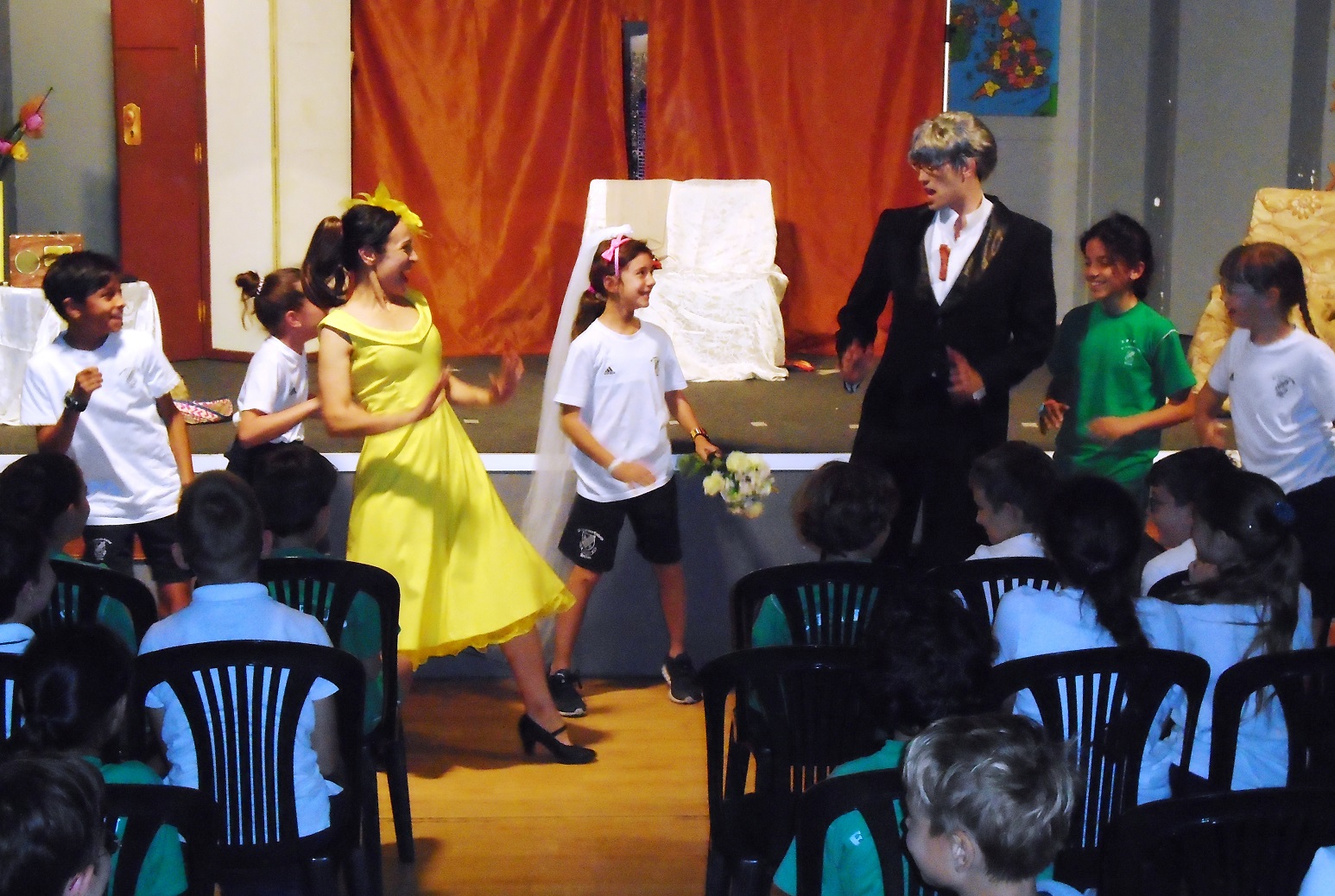
Well, Monday 8th May started the week off with a bang! It was an excitingly different morning for Years 2, 3 and 4 when “The Beast” visited St Lawrence College in the Cultural Hall. The English Theatre Club’s musical rendition of 'Beauty and the Beast' had the children mesmerized and actively engaged in their production of this classic. “Beauty” was put in jail, entertained by Mrs Potts the Teapot, Lumiere the Butler, Cogsworth the Clock and let’s not forget Philippe, the horse everyone wanted to pet as he trotted around the audience! We all enjoyed the music, the Beast, the laughter and the message that LOVE can transform any beast into a human again.
The following day saw the turn of Years 5 & 6 to enjoy another captivating, interactive performance by the English Theatre Club. The pupils laughed unstoppably at a hilarious performance of 'Plaza Hotel'. The cast invited members of the audience to participate which they did willingly and took on the roles of Juan the Cockroach Exterminator, Suzy the bride, the Mexican band and many more! We could not stop smiling and laughing as they had us captivated at every moment, following the shenanigans of Billy and Suzie’s wedding day in the disatrously disorganised Plaza Hotel. We're already looking forward to next year's treat if they come back a third time to us!
International Award
St. Lawrence College is proud to deliver The Duke of Edinburgh’s International Award
The Award
The Duke of Edinburgh’s International Award is the world’s leading youth achievement award, bringing together practical experiences and useful skills to equip young people for life. Since it was founded, in 1956, by His Royal Highness The Duke of Edinburgh (husband to Queen Elizabeth II of the United Kingdom), over eight million young people have participated in the Award in over 140 countries and territories. Schools, colleges, universities, employers, social clubs, youth organisations such as the Scouts, Girl Scouts and Girl Guides, young offenders’ institutions, religious organisations, sports clubs and more all run the Award.
...the world’s leading youth achievement award...
St. Lawrence College has a long history of offering the International Award to young people aged 15 to 18 and the numbers of pupils involved has grown steadily over the years, making it one of our most popular activities.
What is involved?
The Award is voluntary, non-competitive, enjoyable and balanced, and requires effort over time. There are two levels of the Award at our school: Bronze and Silver.
The Bronze Award
The Bronze award is open to Year 10 pupils and its club meets once a week after school, from 3.30 to 4.30 pm. For the Bronze award, children are expected to undertake four adventurous expeditions –to Mt. Parnitha, Mt. Hymettos, Mt. Helikonas (with overnight camping) and Kea Island (with overnight camping).
The Silver Award
The Silver Award is open to pupils from Year 11 and above, who meet occasionally during school lunchtimes and more frequently prior to expeditions. For the Silver Award, children are expected to undertake two treks –to Mt. Menalo and Mt. Parnassos (3 days and 2 nights each).
Young people design their own Award programme, set their own goals and record their own progress. They must complete voluntary work, commit to physical recreation, learn a new skill and go on an expedition. During the expedition, they are only competing against themselves by challenging their own beliefs about what they can achieve.
More information on The Duke of Edinburgh’s International Award can be found at www.intaward.org.
Exploring the World of Illusions
On Tuesday, March 28th, our Year 8 pupils had the opportunity to visit the Museum of Illusions in Monastiraki, which offered an enthralling blend of visual, sensory, and educational experiences, welcoming our pupils to immerse themselves in the fascinating realm of illusion. Within its walls, our Year 8 pupils were treated to a diverse array of exhibits, ranging from the expansive infinity tunnel to mesmerizing kaleidoscopes, lifelike holograms, mind-bending hollow face illusions, and intricate stereograms featuring pictures within pictures.
Furthermore, they enthusiastically engaged in stimulating brainteasers and puzzles, igniting their curiosity and fostering a deeper understanding of optical illusions. Particularly captivating were the perplexing anti-gravity room and the disorienting vortex tunnel, where pupils found themselves thoroughly absorbed in exploring the boundaries of perception.
Through this visit, our overarching goal was to cultivate curiosity among our young mathematicians about vision, perception, the human brain, and their intricate relationship with Mathematics. Remarkably, this goal was met with resounding success as pupils emerged from the experience with newfound intrigue and appreciation for these interconnected fields.
Following the enriching journey through the museum, our pupils had the opportunity to unwind and socialise at the nearby cafeteria, enjoying hot chocolate and sweet bakery treats. This provided a delightful conclusion to the day's adventures, allowing them to relax, chat with friends, and even make new acquaintances outside their usual circles.
The Mathematics trip to the museum proved to be an enjoyable and enlightening experience for our Year 8 pupils, leaving them with lasting memories and a deeper appreciation for the wonders of illusion and Mathematics.
Junior Duke
St. Lawrence College is proud to be a Junior Duke School.
The Junior Duke Award, created by Capable Kids, is an original and innovative initiative that offers children opportunities for growth, achievement, and learning beyond the classroom. Covering a wide range of practical, real-life skills, it encourages pupils to challenge themselves, develop resilience, and discover new talents and passions. Since its launch in 2007, the Junior Duke has supported thousands of children aged 3–13 in building confidence and life skills.
Although not connected to or endorsed by the Duke of Edinburgh’s Award, the Junior Duke shares the same spirit of personal challenge. The scheme has been widely praised for its impact, with inspectors at its original Scottish school commending it as an example of “sector-leading, innovative practice”.
helping children develop independence, perseverance, and life skills
At St. Lawrence College, the Junior Duke complements our long-standing commitment to offering pupils much more than classroom learning alone. It plays a key role in helping children develop independence, perseverance, and life skills in a safe yet adventurous way. The award is voluntary, non-competitive, and family-oriented, requiring pupils to dedicate time outside of school to complete their annual challenges.
The programme is open to all pupils, starting from the Early Years with the Nano Duke Award, and continuing through to Year 6 pupils who can achieve the prestigious Platinum Junior Duke Award.
As founder Dawn Waugh explains: “I hope that, over the years, thousands more children can achieve new heights and grow in confidence through taking up this Junior Duke challenge.”
Further details about the Junior Duke can be found at Capable Kids.
Extra-curricular Activities - Junior School
Extra-curricular clubs provide pupils with wonderful opportunities to make new friends, stay active, and develop new skills in a safe and supportive environment. At St. Lawrence College, we offer a wide range of clubs — from infant activities to chess — ensuring there is something to suit every interest. Clubs run both during the school day (at lunchtime and within school hours) and after school from 3:30–4:30pm and are available to pupils from Foundation Stage 1 through to Year 6. Our outstanding facilities, including a 25-metre heated outdoor swimming pool, outdoor tennis courts, an all-weather pitch, a large sports hall, and an athletic running track, support the breadth and quality of the activities on offer.
opportunities to make new friends, stay active, and develop new skills
Team Sports
Many of our clubs encourage teamwork and physical activity through both indoor and outdoor sports. Popular choices include football, rugby, tennis, basketball, volleyball, karate, rhythmic gymnastics, dance, and more. All sessions are led by fully qualified, professional coaches, who bring their expertise to provide high-quality coaching for pupils of all abilities.
Swimming
Swimming is not only a life-saving skill but also the gateway to many enjoyable water-based experiences. At St. Lawrence College, we offer afternoon swimming lessons for pupils aged 2½ to 18, taught by friendly, caring, and fully qualified instructors. Structured lessons cater for all levels, from water-confidence classes through to advanced club swimming.
Music
Music is at the heart of our school culture. We believe it is a creative and social art to be enjoyed by all, and our after-school Music School provides pupils with the chance to explore their musical interests. Instrumental tuition is offered in piano, guitar, violin, and drums, with pupils also able to prepare for the Associated Board of the Royal Schools of Music (ABRSM) examinations.
Other Clubs
Alongside sport and music, pupils can enjoy a variety of other activities across the year. These include Choir, Drama, Chess Club, Art Club and Robotics.
Practical Details
At the end of the summer term, families receive information outlining the full range of clubs available for the following academic year. This includes details of the age groups, times, and any associated costs, helping families to plan ahead and choose the activities best suited to their child’s interests.
Robotics News
With great enthusiasm, our Junior School Robotics Teams entered the Panhellenic Educational Robotics Competition on Sunday 19th March. The theme was “How can we make our cities SMART?”
Year 6 pupils designed SMART traffic lights to improve city life! Their mantra? ‘We have decided to start the change that will improve the world – one step at a time, one traffic light at a time!’
Year 5 pupils designed SMART cities with underground roads, flying trains and green parks to relax in with safe play environments for children. They said, ‘World... a round of applause for an invention that will change the way our cities deal with waste. The BINBOT – a new garbage management system!’
The commitment these pupils showed as they strove for their team’s success was a credit to them! We are certainly looking forward to next year!
Festival Time!
On Friday 19th October 2018, all and sundry gathered at St. Lawrence College for a celebration of all things autumnal. There were the usual collection of fancy dress ghosts, ghouls, witches and zombies as well as what must surely be the biggest and best display of carved Jack O Lanterns Athens has ever seen! It's amazing how the families of the Junior School, whose classes have this annual pumpkin competition, become more and more creative with every passing year. The time and effort that goes into putting together our amazing pumpkin display is astounding, so our sincere thanks go to all who contributed to it again this year.
As well as the Halloween flavour in the air, there was plenty of entertainment for young and old with a DJ to get everyone dancing, stalls of goodies and gifts and those where you could buy drinks soups, mouth-watering hot dogs and souvlaki to indulge in too! The pupils of the Senior School Council organised games and activities to amuse all kinds of willing participants so all in all everyone was kept quite busy! Here's to next year!
Autumn Festival 2017
It barely felt like the end of summer, let alone autumn, on the warm evening of Friday 20th October 2017 when the St Lawrence community put on its biggest bash of the year. Wizards, witches, ghosts and skeletons filled the school grounds and the smell of sizzling souvlaki enticed everyone to eat, drink and be merry!
The night was the finale to a two-day celebration in the junior school which saw the return of the classic Spook House created to shock and thrill the children in traditional Halloween style! In addition to the treats, food and drink on offer, there were of course the fantastic pumpkins on display; they seem to get more creative and ambitious in design every year!
The senior school also used the opportunity to support the charity Khora which helps refugees here in Athens, and the school council gave children the opportunity to throw wet sponges at some of the senior school pupils, all for a good cause!
When the pumpkin class prizes had been awarded and the music was finally turned off, the party came to an end, but what a success it was! Here's to next year!